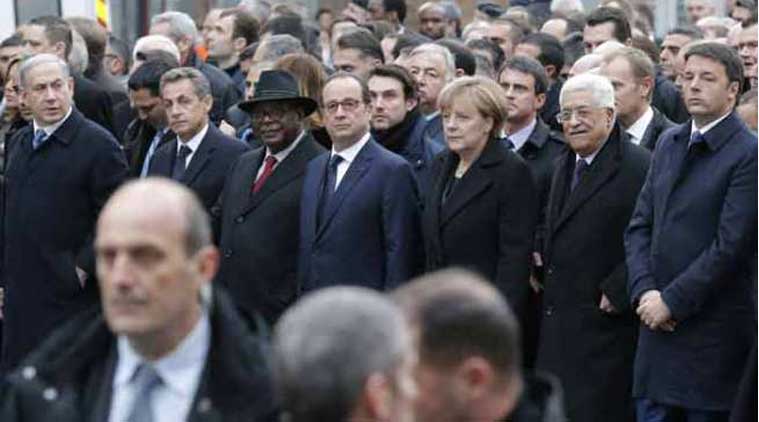
Two weeks ago, Islamic extremists staged an attack on the
headquarters of the French weekly "Charlie Hebdo". That attack in
itself cost the life of 13 innocent French people. A couple of days ago then,
3,7 million Parisians took to the street in order to stand for freedom of
speech, against extremism.
As a society of the 21st century we still have to think about what the attacks should teach us and what they should make us aware of.
Most importantly we have to think of how we want to apply
secularism to our societies: the Oxford dictionary defines secular as "Not
connected with spiritual or religious matters", therefore living in a secular
state means that we live in a state which is independent from religion. Back in
the day, centuries ago as far as Europe is concerned, this idea mostly had
political implications. And even though religion did, as a result, not have any
impact on politics anymore, pretty much each and every individual strongly
believed in some kind of God or any divinity that applies to the different
regions and beliefs. If we take a look around the world we can see many
different intensities of secularism. Let's firstly take Iran, or as it is
officially known The Islamic Republic of Iran, for example. As its name
suggests, religion and religious leaders still play a huge role. State and
religion are closely connected and the idea of secularism is still far from
reality. Our next stop is Turkey. A country, which since its formation after the
collapse of the Ottoman Empire, is officially a secular one. While the
religious influence is on a level which is certainly far from the level which
we can observe in Iran, the country is even today struggling with figuring out,
how important religion actually is for it. Yesterday, the first
"post-attack" edition of Charlie Hebdo was published in France and
today the Turkish daily "Hürryet" published a translated version of
some of the cartoons, which were shown in the latest edition of Charlie Hebdo.
None of them showed the Muslim prophet Muhammad. And still the police raided
the printing press of the newspaper and a court in Turkey ruled that none of
the cartoons from the latest Charlie Hebdo magazine shall be accessible through
the Internet. The just of it is, that at this point religion does indeed impact
"normal" live severely. In fact, everyone who has been to Turkey
before will be able to confirm how much religion influences daily life. Many
more people believe in the idea of religion and follow the rituals that come
with that, than it is the case in more Western European countries, especially
Britain, France, Germany, and the Benelux countries. So even though in Turkey,
religious leaders do not have a serious influence in politics, the religious
ideas and habits have an increasingly strong influence on politics, especially
with Erdogan being the president.
So where can we see the deepest secularism? Well, I believe that
is the case of Central, Northern and Western Europe, as well as parts of Asia,
where there are values and ideals represented in everyday life which can be
traced back to Buddhism. As a student in 21st century Germany, I feel that
here, secularism goes beyond the idea of separating politics from the church.
Here, and most certainly also in other European countries, it can be observed,
that society and everyday life are secularized as well. This doesn't
necessarily mean that people just don't believe in God or any kind of religion
anymore, but that most people are so tolerant that they just don't really care
or simply shouldn't care. I believe that if people feel that they want to
believe in the ideals, philosophy, individuals, sacred places or what they
connect with their religion, they are welcome to do so and no one should
question them for doing so. In return, that also means that those who believe
in a divinity should tolerate those who believe in something else or
nothing at all. And that is exactly the point where we return to the Charlie
Hebdo attack which was apparently triggered through the paper publishing
drawings of the prophet Muhammad. Now I do certainly agree, that directly
insulting, discriminating or hurting people on purpose is nothing that should
happen - not for their skin colour, hobbies, religion, food preferences, looks,
abilities or anything that one could imagine, but is that what Charlie Hebdo
did? Did they directly target Muslims and insult them? Well, they didn’t. They
do as a matter of fact do not target any specific religion. It happens just as
well that they publish cartoons that make fun of Christianity. Should they be
allowed to do so? Of course they should. Why? Well, with humour which is not
directed strictly against a certain ethnicity or religion, you do quite frankly
not spur hatred by any stretch of the imagination. If I don’t like that a
certain magazine mocks ideals of mine, I just don’t read it. I don’t even
consider buying it. Let’s take a very simple analogy here. Imagine you were the
greatest football fan ever. Would you buy a basketball magazine in which every
now and then they have cartoons where they mock football? No, of course not.
And you wouldn’t even care if they publish those cartoons, because you wouldn’t
see them. One might make the argument now that one can’t compare religion to
football and to be quite honest, I agree with that in certain circumstances. In
countries like Iran or even Turkey it’s probably not possible to compare because
in those two countries, religion has such a high and important standing that it
sets itself completely apart. If we take the issue to Europe, however, things
are very much different. Football, or any hobby can be the great passion of any
individual, just as any religion. Those people will certainly feel insulted if
somebody mocks their sport, their great passion. But should we therefore forbid
any kind of opinions or cartoon? No. Of course not. That’s what freedom of
speech consists in.
To come to a conclusion on that point – yes, satirical newspapers
should indeed be allowed to mock anyone and anything they want, as long as they
don’t just target one group which is made fun of. That is how societies work.
As long, as mocking and poking about doesn’t turn into hatred and
discrimination, it’s all fine. One must not directly feel insulted just because
someone is making fun of him for once.
If you’re living in one of those highly developed countries like
Germany, U.K. or France, at some point you have to accept that you’re living in
a heterogeneous society in which we need to learn to live with all those other
cultures, religions and passions. In the end we all share the same values.
Apart from religion, we live the same lives and experience the same things.
Those common values should not be questionable under any circumstances.
Democracy, freedom, openness to different beliefs, to advances in science, open
markets, social systems and so on. All those values are unquestionable in Western
European countries and rightfully so. It doesn’t matter if there are more
mosques than churches or any at all, as long as we all recognize those values
and respect them above everything else. If you don’t feel comfortable in that
certain environment you are welcome to move to a place where the environment
looks the way you imagine it to be. If you don’t like depictions of your
divinity to be shown on any kind of paper in any kind of context and therefore
don’t agree with the principle of freedom of press, of speech and the idea that
we must tolerate all those living among us, then the E.U. is not the place for
you, whether you are Christian, Muslim, Buddhist or any other practitioner of
religion.
The most pure expression of freedom of speech, at this moment, can
be found in France, where the French people at Charlie Hebdo made fun of the
Pope, of Christian Priests, of their president, Muhammad and of internationally
known and dangerous terrorist leader Abu Bakr al Baghdadi. For this freedom,
history has shown us that French people have willingly sacrificed themselves
over and over again and they will continue to do so – 3,7 million people in
Paris confirmed this.
In a free society, you are free to ignore or attack in a justice court the things which disturb you in one way or another – and you will get justice, whether you win or lose the trial.
In a free society, you are free to ignore or attack in a justice court the things which disturb you in one way or another – and you will get justice, whether you win or lose the trial.